
WARNING THIS ARTICLE CONTAINS SPOILERS
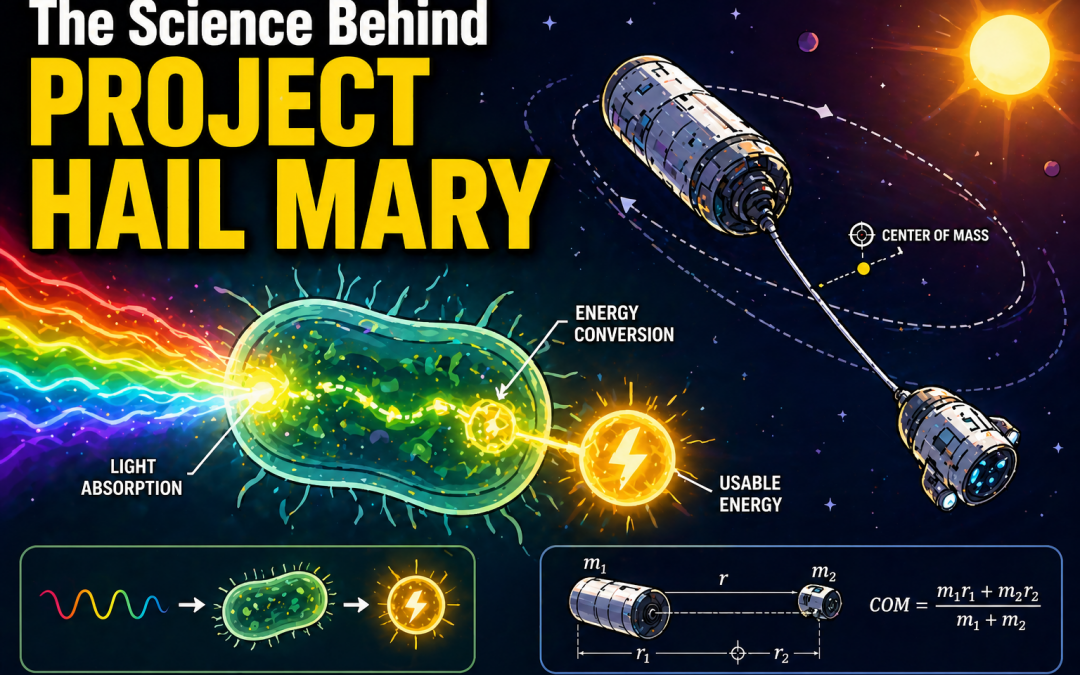
As you may know, a new film has arrived on the market, based on the book Project Hail Mary by Andy Weir. When I exited the cinema, my head was spinning from the amazing scenes, thinking about how it would work in real life, and, most importantly, questioning if the science behind it was real! As a result, I chose to write an article based on the science of Project Hail Mary. However, I chose to go with the book, as although there are no major differences in the plot, some parts had to be cut out from the film, as it would take extremely long (even so, it was 2.5 hours).
WARNING THIS ARTICLE CONTAINS SPOILERS
As you may know, a new film has arrived on the market, based on the book Project Hail Mary by Andy Weir. When I exited the cinema, my head was spinning from the amazing scenes, thinking about how it would work in real life, and, most importantly, questioning if the science behind it was real! As a result, I chose to write an article based on the science of Project Hail Mary. However, I chose to go with the book, as although there are no major differences in the plot, some parts had to be cut out from the film, as it would take extremely long (even so, it was 2.5 hours).
The Plot of the Project Hail Mary
The Plot of the Project Hail Mary

The plot is rather simple, but the science behind it is amazing. A schoolteacher named Ryland Grace wrote a paper a long time ago about his beliefs that some life might not be water-based. However, he was kicked out of university for calling the main scientist ‘a waste of carbon’ as they denied his paper. When astrophages are found by a probe, migrating from the Sun to Venus, the problem is clear – the Sun is dimming. Eva Stratt, an administrator at ESA, calls Grace up. Obviously, a living organism would not be made of water if it lived in the Sun.
The plot is rather simple, but the science behind it is amazing. A schoolteacher named Ryland Grace wrote a paper a long time ago about his beliefs that some life might not be water-based. However, he was kicked out of university for calling the main scientist ‘a waste of carbon’ as they denied his paper. When astrophages are found by a probe, migrating from the Sun to Venus, the problem is clear – the Sun is dimming. Eva Stratt, an administrator at ESA, calls Grace up. Obviously, a living organism would not be made of water if it lived in the Sun.
Turns out, when he did the X-ray fluorescence spectrograph, it was made up mostly of hydrogen and oxygen. 2 to 1 (water). By that time, he is way too submerged in studying astrophage, and finds out that all the nations have collaborated to build a ship called the Hail Mary. It is designed to send 3 people to Tau Ceti, the only star that is immune to the infection. Grace also discovers how to breed astrophage, and finds out. When both the lead scientist and his replacement explode in a failed astrophage experiment, Grace is forced to go.
On the way, he meets an alien called Rocky, from the planet 40 Eridani, whose planet is suffering too, and using a spectrum analyser, he can decode what he is saying. They go to Tau Ceti and find out that Taumoeba (courtesy to Grace for naming it) is eating the astrophage. Meanwhile, it turns out that Rocky and all the other Eridians had no idea of special relativity, and had way too much fuel. And for him, it was meant to be a return journey, unlike for Grace, which meant that Rocky could refill Grace’s tanks.
They isolated the taumoeba and simulated the environment of Venus and Threeworld, the planet with CO2 closest to the corresponding star. Unfortunately, nitrogen, which was present in both planets’ atmospheres, was lethal to taumoeba in even small amounts. Rocky then produced containers out of xenonite (an extremely hard substance Eridians invented) in which they bred the taumoeba to survive small concentrations of nitrogen.
However, while living in xenonite, the taumoeba evolved to weave through the crystalline structures, causing havoc in Rocky’s ship (which was made of xenonite), when the taumoeba escaped and ate the astrophage in the fuel tanks. Grace returned and helped Rocky return to Erid, instead of going home, which meant that he had to learn to survive there. The problem is that Eridians live in temperatures of 210 degrees C at a pressure of 29 atm, in ammonia. The other Eridians are very helpful and create a biosphere where he can live, and, most importantly for him, teach other Eridians.
A Diet of Light: How Astrophage Store Their Energy
A Diet of Light: How Astrophage Store Their Energy


Technically, instead of converting it directly to mass, the most likely (still very unfeasible) explanation is that it pushes the energy into a special, exotic molecule, where the electrons shift to higher electron energy states, storing the energy. However, this increases its mass, as, as absurd as it sounds, energy contributes to the mass of a system via relativity. However, such a super stable exotic particle does not exist in physics, as at those energy levels, every type of atom would turn into an ion (an atom with a positive or negative charge), as the electron would escape at such energies. It is also super cross-sectional, which means it absorbs almost all wavelengths of radiation. In particle physics, cross section refers to how likely a particle is to interact with radiation. Normally, particles have tiny cross sections, but astrophage have ‘super cross-sectional’ particles, where the cross section is so abnormally high that they interact with almost all wavelengths or strengths of electromagnetic radiation. It is important to note, that such properties of a particle are almost impossible to achieve.
The Science of The Centrifuge
The Science of The Centrifuge
In the book, the Project Hail Mary has a centrifuge to create artificial gravity, so the many instruments on board (in the film, if you paid attention to detail, you will have noticed that all the microscopes were from Leica Microsystems) could function. In the book, it specifies that, when fully spun up, it has an rpm of 5. That means it turns on its axis of rotation 5 times every minute. This may seem small, but the further you go from the axis of rotation, the larger the centrifugal force, so the slower the rpm needed to sustain 1G. Based on estimates from diagrams in the book, we can find out how long the cable is.
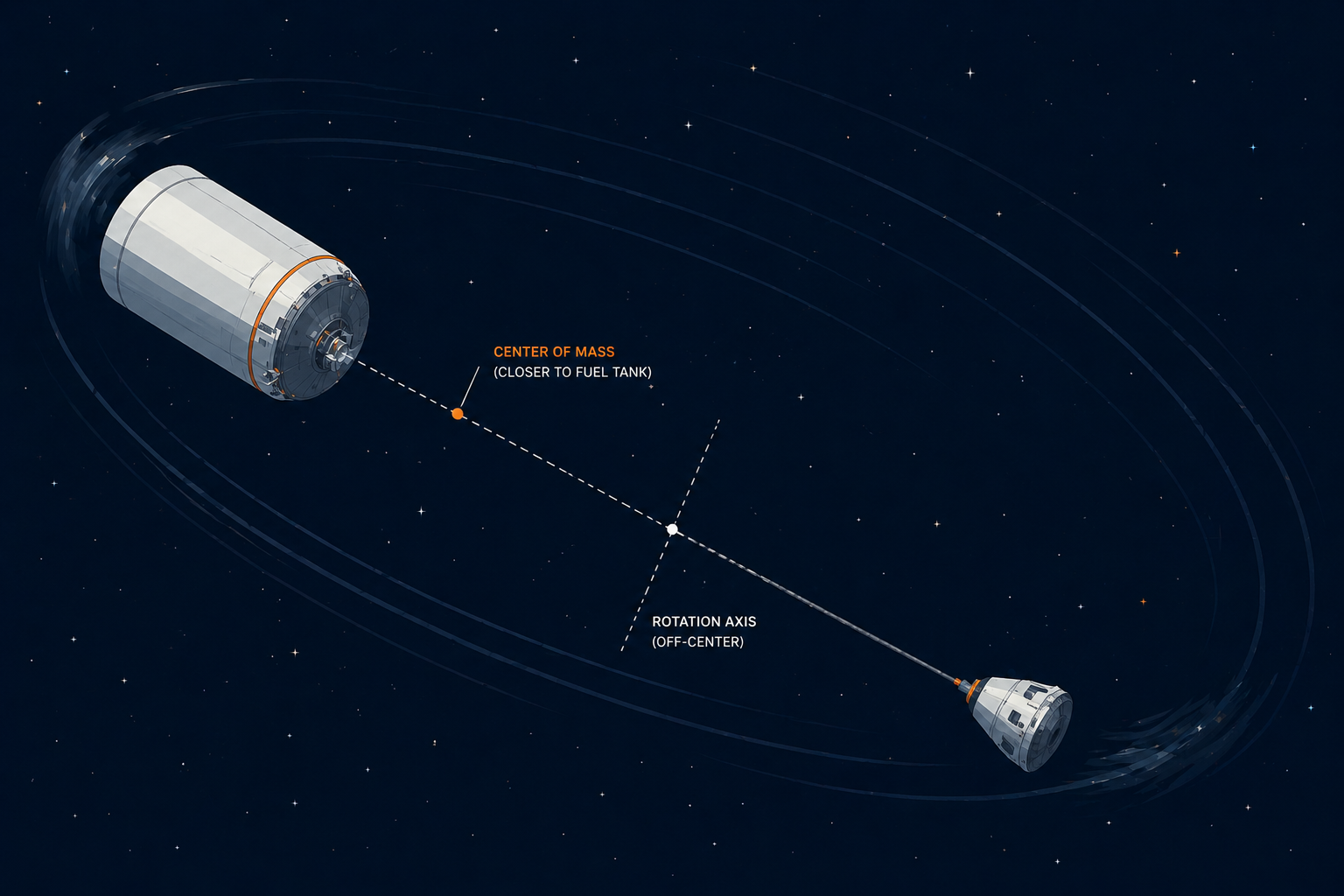
Using an online calculator (https://whycalculator.com/rpm-to-rad-s-calculator/), we can find out that the rate of rotation is around 0.542 radians/s. As we know that Grace feels around 1G, we can find the distance from the rotation axis by using a rearranged formula for centripetal acceleration r=a/ω², where r is the distance from the rotational axis, ω is the rate of rotation, and a is the gravitational acceleration.
On Earth, or in a 1G environment, it is 9.8 m/s². We can then substitute into the formula to get r=9.8/(0.543)². This then turns into r=9.8/0.274, which equals 35.8 m. However, the ship rotates around an imaginary axis, and this isn’t the complete length. Using the ‘density’ of the Saturn V’s fuel tanks, we can find the mass ratio of the fuel tanks to the cabin. The diagram in the book helps visualise this, but, due to copyright reasons, I can’t put that up here. However, I have pasted a link to a Reddit page with the schematics: www.reddit.com/r/ProjectHailMary/comments/ngsj27/ok_this_is_more_accurate_a_ship_drawing_and_its/ I have assumed a 5× cabin mass for the fuel tanks. This translates to around a 43 m cable. This is completely feasible, even by our standards, but a much more practical, ring-style centrifuge could have been used.
The Biology of Eridians
The Biology of Eridians

Arguably, the most fascinating point (or character) in the entire book is Rocky, the Eridian. He lives at a pressure of 29 atmospheres, in a place where there is no light, in ammonia, which, for context, is very bad for the human body, and, aside from smelling awful, effects of breathing it in include swelling of the lungs and throat, severe chemical burns, cell membrane damage, liquefaction necrosis, and protein denaturation (none of which is particulary good for you). This is at room temperature and at 1 atmosphere. At 210 degrees C and 29 atm, this is an extremely hostile environment to be in.
They rely on two circulatory systems, one hot at around 305 degrees C (HCS) and the other ‘ambient’ (still extremely hot by our standards) (ACS). They have spongy sac-like tubes instead of muscles, filled with a small amount of water. At that pressure, water is liquid at 210 degrees C, but supercritical (in between a gas and liquid) at 305. The sponge is filled with both ACS and HCS capillaries, and the Eridian can toggle between them, which would allow the water to evaporate (and take up more space) or condense (and take up less space) at will, resulting in a contraction or expansion of the muscle.
They also go to sleep at seemingly regular intervals to repair the body, switching their entire system to the ACS. This is essential, as they have worker cells in their bloodstream that cannot survive in the HCS. Therefore, all the water in them turns into a liquid, and they are paralysed for an unknown amount of time that can vary greatly. This is likely where the (slightly creepy) habit of watching each other when they sleep came from, as they are physically unable to respond to danger.
Their communication is fascinating as well. Instead of having a single vocal port like we do (the mouth), they have 5 pairs of bladders in which they pump air from one to the other. This allows them to make multiple sounds simultaneously, allowing for a much more efficient language system which, according to the Fandom, has 6× the content density of human languages.

Conclusion
Conclusion
In conclusion, Project Hail Mary was an incredible book, not just because of the plot, but because of the science Andy Weir implemented into it. Rocky was one of the most scientifically plausible aliens in sci-fi history, the centrifuge speeds and parameters were completely feasible, and even the main character used working scientific techniques and calculations in the novel. This book, in my opinion, is well worth a read for anyone who likes physics, maths, chemistry, biology, or just science fiction in general. Comment down below what you think alien life would look like – or whether you think it even exists. Also, since I am doing a different kind of article which will answer one of your questions, please do comment on what you think I should write about!