‘We are all made of stardust’ or so the saying goes, but have you ever wondered how much of this is true? In this article, I explore the science behind the saying, and dive deep into the origins of the universe!
The validity of the saying depends on how you interpret ‘stardust’. Physically, the atoms we are made of did originate from stars (except Hydrogen), but it is not ‘stardust’ in a conventional sense, but by-products of nuclear fusion reactions, supernovas and, from the beginning of the universe. When the Big Bang occurred, the universe was little more than a bundle of forces. The main forces, (Gravitational force, Electromagnetic force, Weak nuclear force and Strong nuclear force) were bundled up in a chaotic superforce.
‘We are all made of stardust’ or so the saying goes, but have you ever wondered how much of this is true? In this article, I explore the science behind the saying, and dive deep into the origins of the universe!
The validity of the saying depends on how you interpret ‘stardust’. Physically, the atoms we are made of did originate from stars (except Hydrogen), but it is not ‘stardust’ in a conventional sense, but by-products of nuclear fusion reactions, supernovas and, from the beginning of the universe. When the Big Bang occurred, the universe was little more than a bundle of forces. The main forces, (Gravitational force, Electromagnetic force, Weak nuclear force and Strong nuclear force) were bundled up in a chaotic superforce.
Nuclear Fusion: the Cosmic Genesis
Nuclear Fusion: the Cosmic Genesis
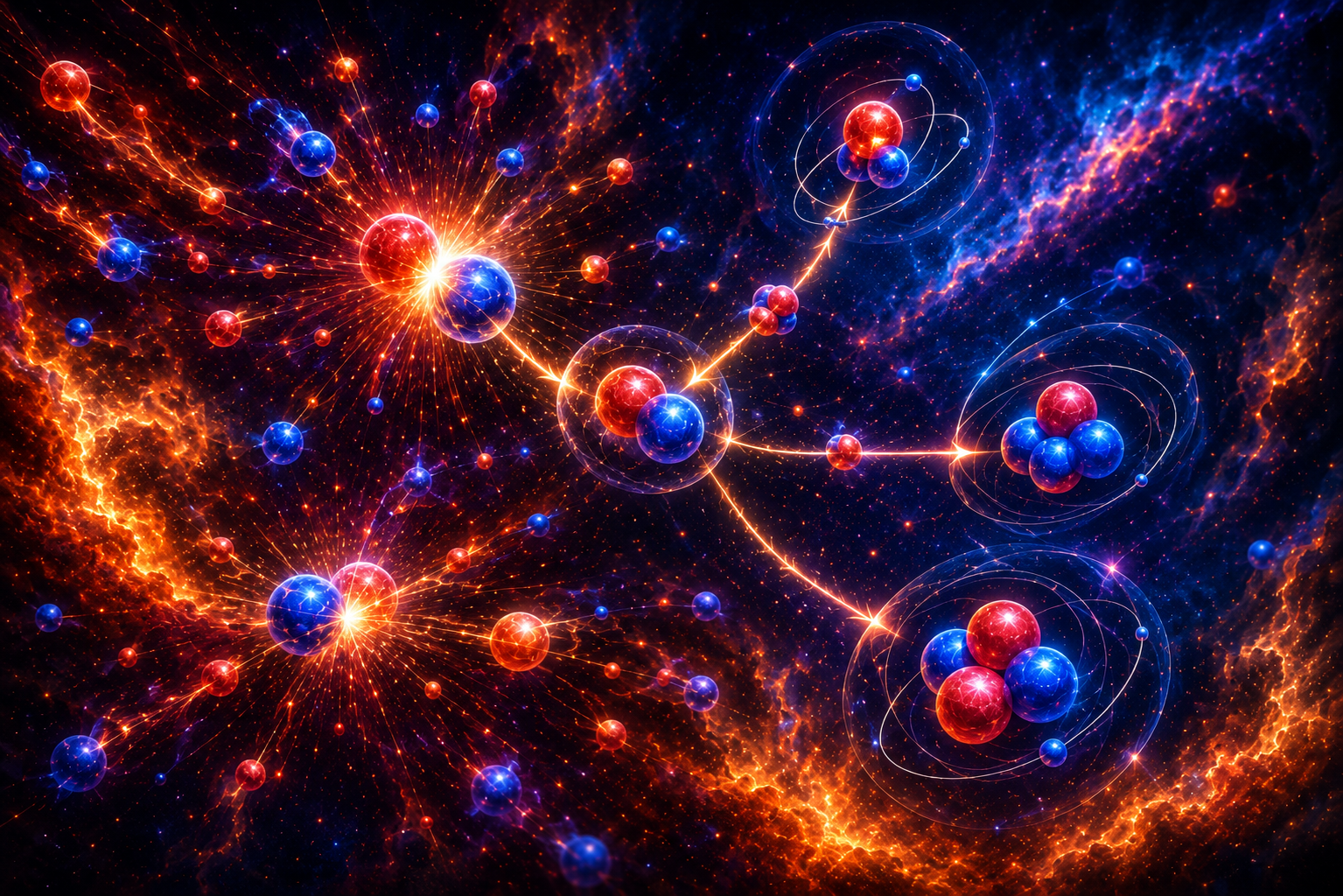
Most principles of physics broke down at that point, so it is very unclear what had happened. However, we know that, around 3-20 minutes after the Big Bang, newly created protons and neutrons fused to form Deuterium, a heavy isotope of Hydrogen. An isotope is a form of an element that contains different numbers of neutrons. For example, Deuterium and Tritium are both isotopes of hydrogen, as they both have only 1 proton. However, Tritium has 2 neutrons while deuterium has only one. They can have different characteristics, vary in radioactivity, and have different atomic masses.
Most principles of physics broke down at that point, so it is very unclear what had happened. However, we know that, around 3-20 minutes after the Big Bang, newly created protons and neutrons fused to form Deuterium, a heavy isotope of Hydrogen. An isotope is a form of an element that contains different numbers of neutrons. For example, Deuterium and Tritium are both isotopes of hydrogen, as they both have only 1 proton. However, Tritium has 2 neutrons while deuterium has only one. They can have different characteristics, vary in radioactivity, and have different atomic masses.
Due to the immense heat and pressure, Deuterium atoms fused to form Helium. Lithium came next (via a process called nuclear fusion), but other elements wouldn’t form until 150 million years later, when stars were first born. Inside a star, the conditions were met to allow heavier elements to form from helium all the way to iron. However iron is too dense to fuse, so it would remain there, until there would be a supernova, where the elements would be dispersed throughout the galaxy.
The Forges of the Galaxy
The Forges of the Galaxy
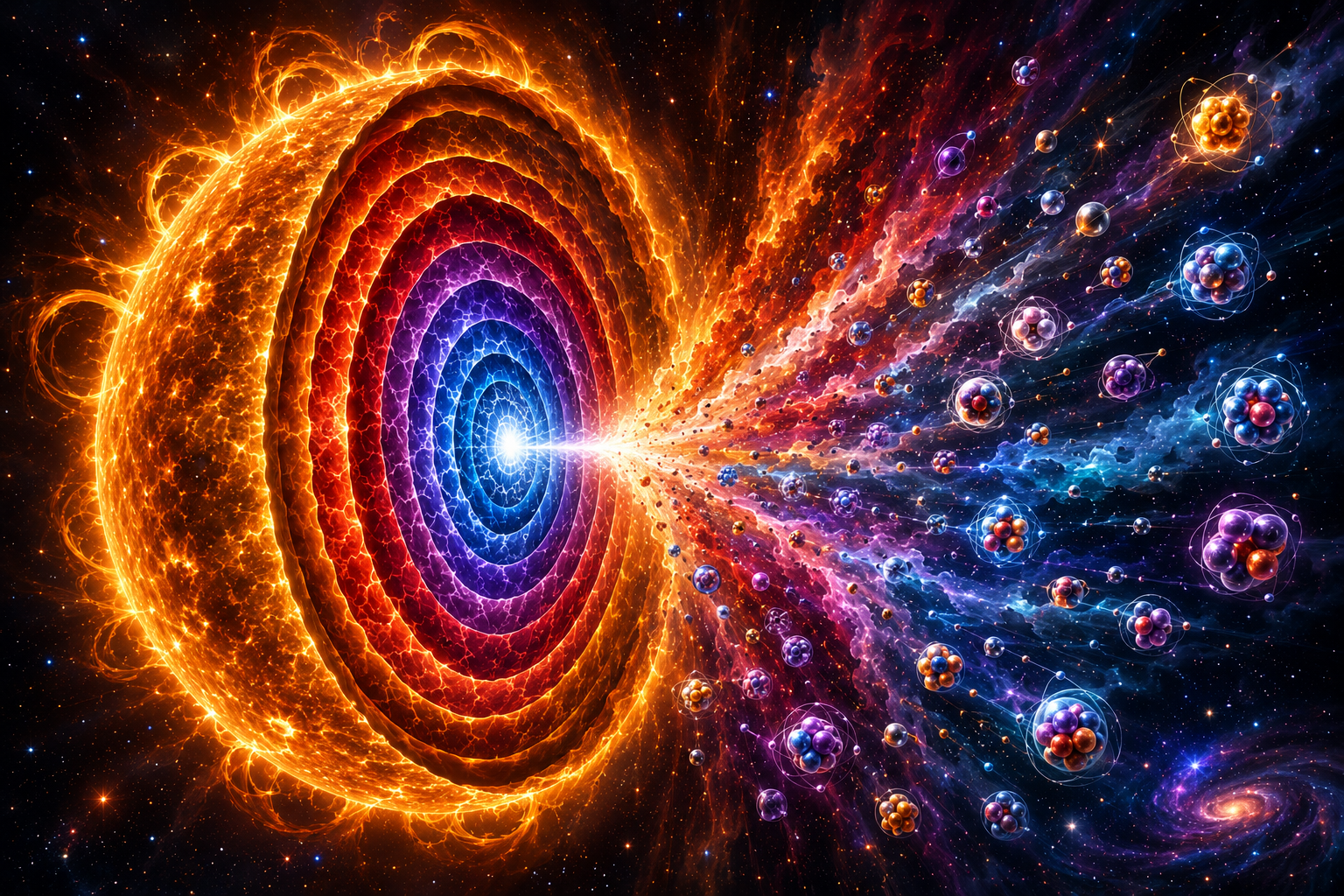
Elements heavier than iron were created during some of the most explosive, violent events in the galaxy. Neutron stars, the remnants of supernovae can collide, causing elements like gold or rare earth metals to form. This, together with all the elements from hydrogen to iron, with the exception of technetium which is completely man made) constitute all the naturally occurring elements in the world.
The Big Catch
The Big Catch
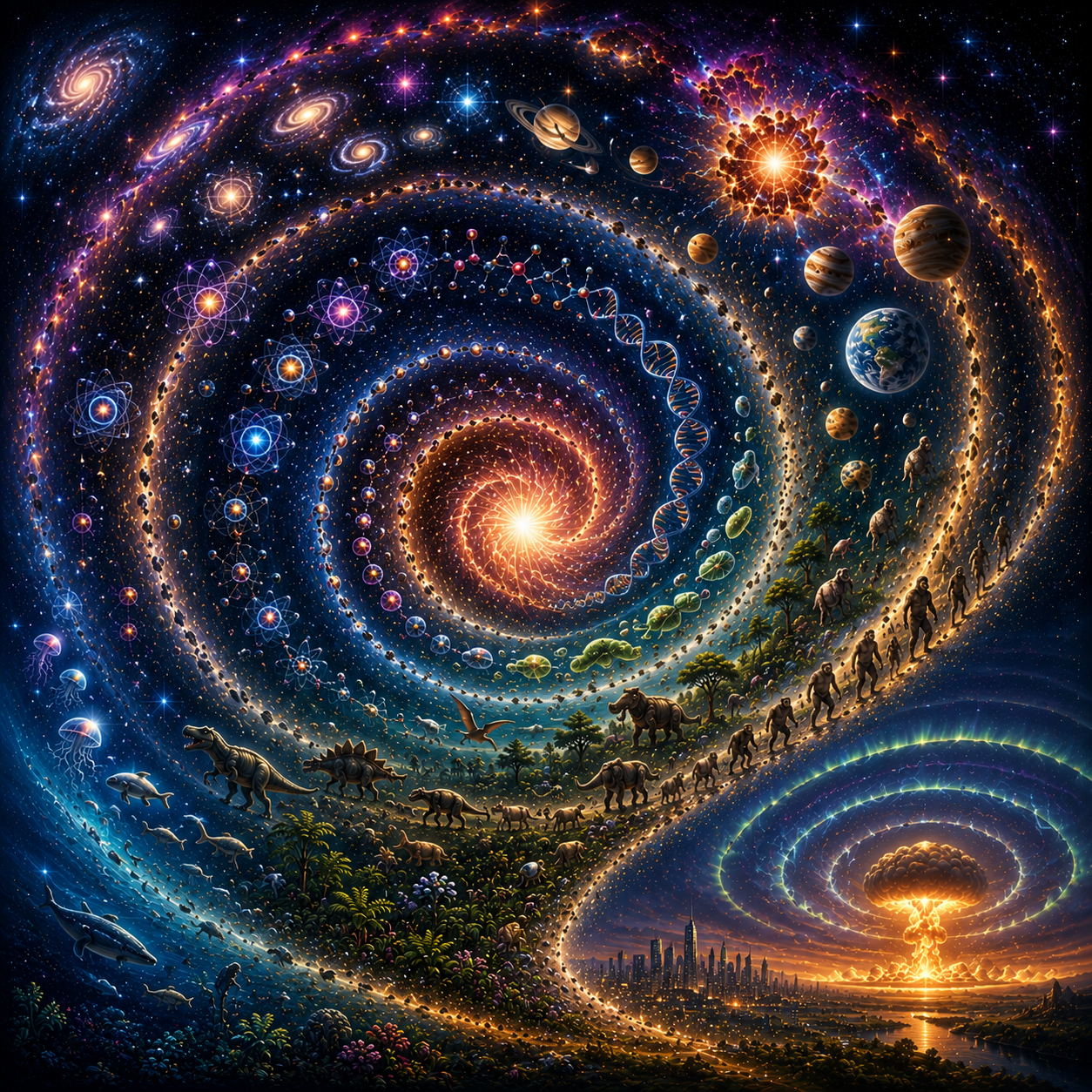
However, there is one special atom that isn’t what I would consider stardust – Carbon 14. Carbon 14 is an isotope of Carbon that is mildly radioactive, and is present in almost all life forms. It is formed when radiation from the sun causes nitrogen 14 to turn into carbon 14 by losing a proton and a subsequent electron. However, intense neutron radiation from nuclear weapons tests from 1945 to 1963, caused a spike in carbon 14 levels, which crucially wasn’t from the sun. This means that, at least a small amount of the matter we are made of, is the direct result of humans. Furthermore, these events also released small amounts of completely human made elements such as plutonium (only a few thousand atoms per person) which is negligible. Despite that, it technically is part of the human body, so, after all, we might not be just stardust. But a large proportion of us is, and, the protons and neutrons and electrons that created the atoms in the first place were from the big bang.
Conclusion and the Return to the Stars
Conclusion and the Return to the Stars
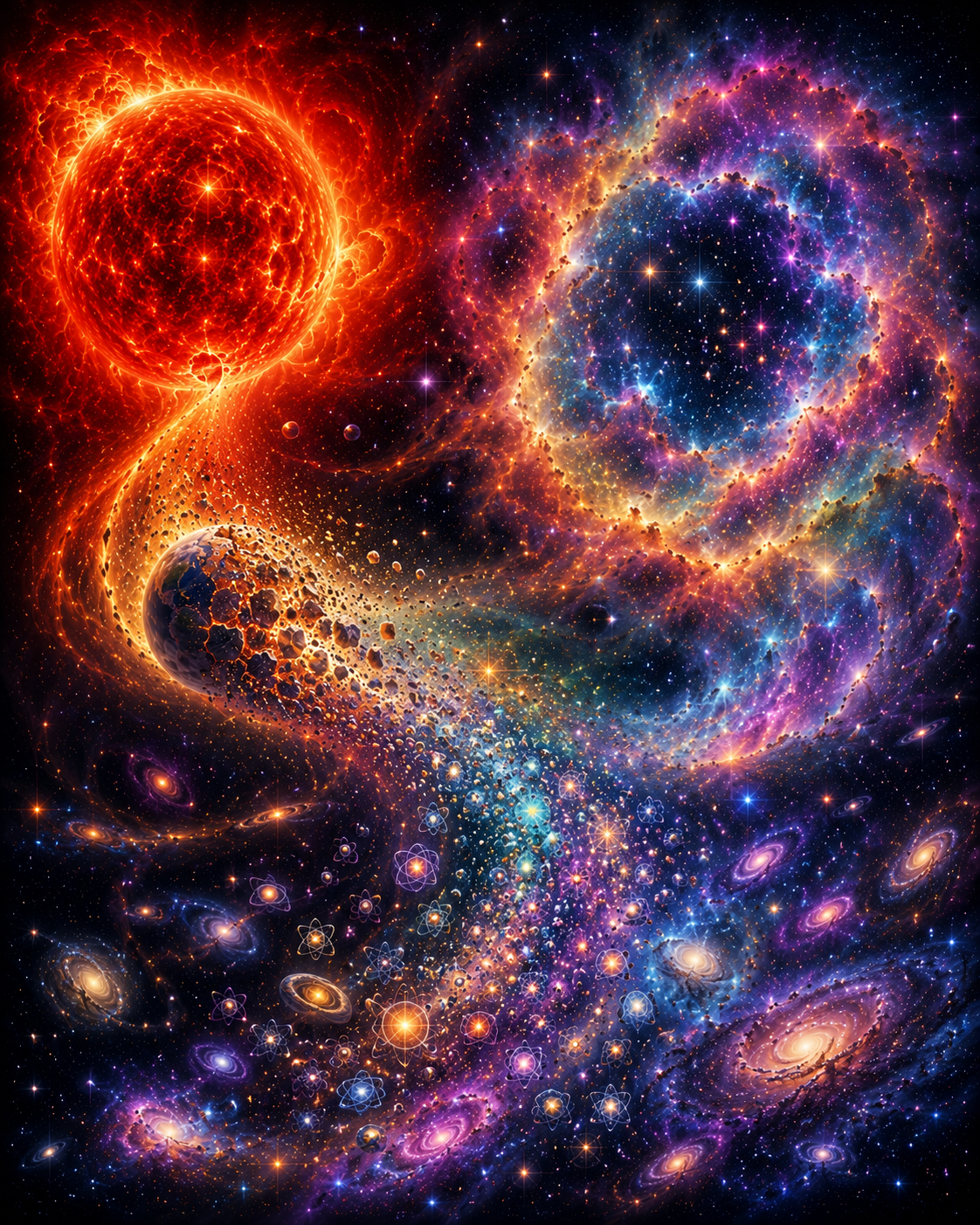
After all, the saying ‘ we are all BigBangdust’ is slightly less poetic, it is definitely more accurate! Also, I like to think about what happens next. After the sun gets old enough to expand to a Red Giant, it will swallow up the earth (by that time, humans will most likely be extinct or at least on another planet) and we will be turned back into stardust, and the cycle is complete! From then on, when the sun sheds its layers, we will be dispersed back into the galaxy, where we came from (and now that extra plutonium and carbon 14 will be ‘stardust’). I take great comfort in the fact that, despite whatever happens on earth, we will all be part of something beautiful – a star!
Once again, you have delighted me with an interesting, thought-provoking article. In the midst of the busyness of the weekdays, we certainly don’t think about where we came from, what we became, we just do our job. At times like these, when I read an interesting piece of writing from you, I am forced to stop and think about how this is possible? I did the same thing now, after reading your article, I asked myself who I am, what I am, where I came from. I almost pinched myself, as if I wanted to wipe a little stardust off myself. Are we really made of stardust, is this possible? The article is very thought-provoking and gives me a little hope that when we are no longer here, we can shine like stars in the sky. Thank you for these new and interesting thoughts that you share with us.